Technology
Aquatron® STP technology and specifications
Separate first, treat second
The Aquatron sewage treatment plant is a solid-liquid separation technology STP: faecal solids are diverted before the plant, so only liquid is treated. That is what makes it a compact STP with no sludge pumps, no presses and nothing for an operator to babysit — a low maintenance STP whose separation stage runs on flush energy alone.
01
Separation
Flush momentum, centrifugal force and gravity part solids from water. No motors, no power, no chemicals.
02
Bio-chamber
Solids dry and compost naturally. Bacteria convert up to 95% into vapour and CO₂, leaving a scoop of soil.
03
Liquid treatment
98% of the liquid joins grey water for aeration and ozonation — a far lighter load than mixed sewage.
04
Polish & reuse
Sand and carbon filtration plus UV disinfection deliver water for gardening, flushing or chiller make-up.
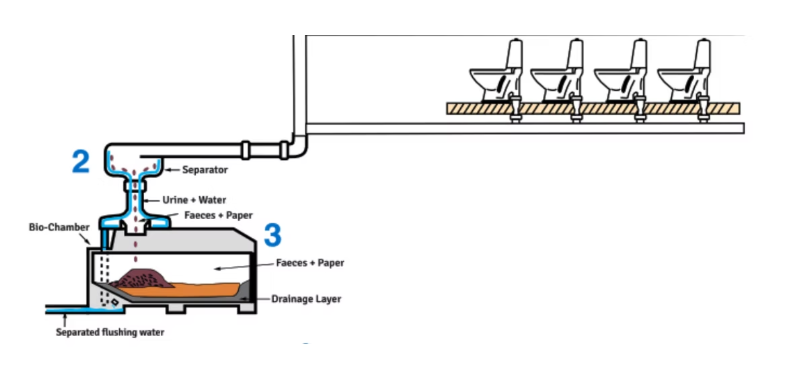
The Aquatron® STP process explained
What does Aquatron® do?
- Separates solids and liquids the instant they arrive
- Uses only the momentum of the flushing water, centrifugal force and gravity
- Stops sludge from ever forming
What happens to the liquids?
- 98% of the liquid is separated off immediately
- The remaining 2% drops into the bio-chamber and drains out
- Separated flushing water and urine can be mixed with grey water
- Separated liquids are then treated to the standard you need with conventional STP stages
What happens to the solids?
- Faecal matter, toilet paper and any other solids fall into the bio-chamber
- Natural bacteria consume and convert up to 95% of it into water vapour and carbon dioxide
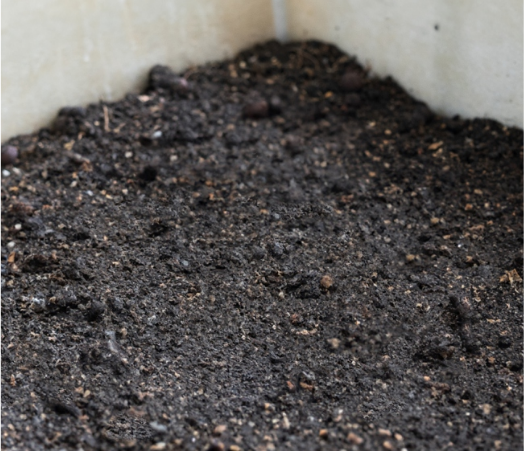
- What is left is a small scoop of hygienic, odourless manure
- The bio-chamber rarely needs emptying, and the compost is easy to handle
- No insects or odours around the dry bio-chamber
Aquatron® versus conventional STPs
Conventional technologies such as MBBR and SBR treat sewage as one mixed stream of solids and liquids. That choice is what produces sludge without pause, pushes up energy use and makes the plant operationally complex.
Aquatron starts somewhere else entirely: solids and liquids are parted at the source. Sludge never forms, and the need for aeration, pumping and manual intervention drops sharply. The result is a plant that is more energy-efficient, easier to run, far less dependent on skilled manpower, and more compact and cost-effective over its life.
By dealing with the root cause of sludge rather than its symptoms, Aquatron offers a more efficient and more sustainable alternative to conventional STP technology.
What comes out the other end
Readings from the 50 KLD Aquatron® retrofit at WeWork BlueOne Square, Gurgaon — combined inlet versus final treated water. Every parameter clears NGT and CPCB limits.
| Parameter | Inlet | Treated | Status |
|---|---|---|---|
| BOD (3 days)30 mg/ltr | 77 | 7.3 | PASS |
| COD100 mg/ltr | 198 | 24 | PASS |
| TSS40 mg/ltr | 97 | 5.2 | PASS |
| Ammoniacal nitrogen5 mg/ltr | 14 | 0.67 | PASS |
| Oil and grease10 mg/ltr | 6.1 | 0.2 | PASS |
| ColiformsCFU/100 ml | 9,100 | 5 | PASS |
| E. coliCFU/100 ml | 128 | Absent | PASS |
Against MBBR, SBR and MBR
A 75 KLD villa layout costs ₹1.64 Cr as a conventional plant and ₹88.9 L with Aquatron® — 45.8% less upfront, and an AMC of ₹3.2 L instead of ₹15 L.
1 MLD project CAPEX
Installed projects, their sites and what changed
Gurgaon, Haryana · 50 KLD
WeWork BlueOne Square
Retrofit around live plumbing. Treated water measured BOD 7.3, coliforms down from 9,100 to 5 and E. coli absent — every parameter inside NGT and CPCB limits.
India · 320 KLD
Apollo Hospitals
A continuous 24×7 load carried with roughly 65% less power than a conventional plant and no operator on shift.
Ladakh · High-altitude site
Indian Army post
Separation runs without any power at all and the bio-chamber sits frost-protected — no sludge to remove in a place where removal is not practical.
Chennai, Tamil Nadu · 110 KLD
Voora's Ocean 27
About 60% less plant area released back to the development, with an AMC of ₹3.2 L against ₹15 L for the conventional option.
New Delhi · 380 KLD
Arun Jaitley Cricket Stadium
Match-day peaks absorbed with no operator on shift and nothing to cart away afterwards.
Wadala, Mumbai, Maharashtra · 380 KLD
Shantilal Sanghavi Cancer Hospital
Odour-free treatment running 24×7 immediately alongside patient areas, with no open sludge anywhere on site.
Wadala, Mumbai, Maharashtra · 160 KLD
Wadala Eye Hospital
A compact footprint on a tight urban plot, with treated water reused for flushing.
India · 75 KLD
Villa development layout
₹88.9 L installed against ₹1.64 Cr for a conventional plant of the same duty — 45.8% less upfront.